Sitting on your desk with no idea? It sometimes helps to see other people’s work. Get inspired by this collection of 80 portfolio designs put together by Nancy Young.
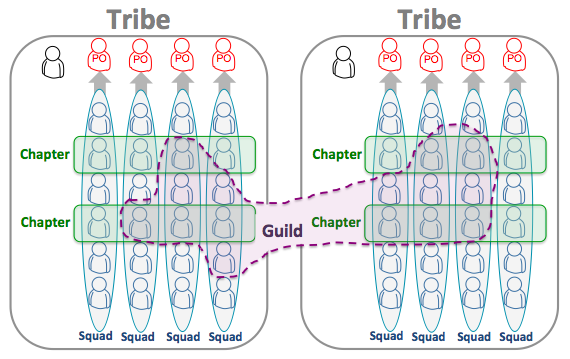
Thanks to Lars for pointing me to this article. It’s a great insight on managing large teams over different locations efficiently. In his November 2012 article, Henrik Kniberg (also see my recent post from him introducing scrum) describes a team setup that combines scrum teams and keeps them interacting with each other.
It’s a challenge I’m currently facing as well setting up the new car2go and moovel development teams. I’ll definitely learn from that input for my further steps!
https://blog.crisp.se/2012/11/14/henrikkniberg/scaling-agile-at-spotify
(Really) Simplify Legal Jargon
The Next Web highlights the “simplified” terms of service of a Twitter rival Heello, Pinterest and 500px in a recent post: Now this is how to write a terms-of-service document.
Don’t get too exited yet. It is a nice idea to highlight the essence of a lengthy, complicated text right next to it. But wouldn’t we all wish to just have easier to understand terms and conditions at all?
What real simplification is, can be seen in a TED session by Alan Siegel: Let’s simplify legal jargon!. He doesn’t mention terms of service explicitly, but he’d sure have an opinion about them.

I remember that my fable for visual note taking started somewhere in school. Just writing down what the teacher said or assembling text as home work was not enough. I needed to add some life to it: Historical topics were framed with country shapes, architecture lessons on gothic churches were brightened up with sketches of windows or architectural artifacts.
Somewhere on the way through university, all this went lost. Meeting notes became all text, technical, detailed, boring and were almost never revisited. I wrote things down to better memorize them for myself, but that was quite a poor way. Then came Evernote which I still enjoy for its simplicity and benefit of searching, tagging and having it on every device I use. But still text only. Here’s how to get better.
Continue reading “Render your ideas into facts – Moving minds with great note taking”
I’ll leave out the question whether we really need a new word like “Shareconomy” for what we do…
Besides that, friendsurance has put together an Infographic showing the companies that form the German landscape of collaborative consumption. It’s beautifully laid-out as a subway net and combines car sharing, other mobility, finance, goods, coworking and more.
“NEXT Berlin” Conference – The New European SXSW?

“Marketing decision-makers and business developers meet technical experts and creative minds to discuss what will be important in the next 12 months”.
Sounds familiar, makes hungry. Berlin could be the place to attract the right folks for a European SXSW! https://nextberlin.eu
Agile Product Ownership
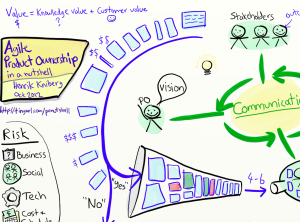
With his 15 minute animated presentation, Henrik Kniberg describes the building blocks of agile product development really nicely.
It all sounds so simple. And actually, it is (while it actually isn’t). To my experience, one key fact for success to agile is achieving a high degree of transparency. No one wants to hear a “no” when asking for a feature. But constituting a “no” with a good reason, like an even better feature, will keep your stakeholders happy.
What do you find hard and how do you address these challenges?
Innovation must be a Leadership attitude
This post “Your Innovation Problem Is Really a Leadership Problem” by Scott Anthony points out several aspects that can help make (or keep) your organization innovative, focusing on the leadership team’s responsibilities.
In daily business, I see two things that seem to be in contradiction by nature: The quality you need for operational excellence vs. ‘fail-fast-attitude’ you need to push future innovation. My favorite quote: “[…] leaders have to figure out how to manage two distinct operating systems: one that minimizes mistakes and maximizes productivity in today’s business versus one that encourages experimentation and maximizes learning in tomorrow’s business. It isn’t either/or. It is both/and. […]”
Insist on quality and encourage experimentation – while this might be conflicting goals, you definitely need to bring them together!
Full story at HBR
Three Things to Boost your Teams
Do you feel people in your teams start loosing the passion they once had for their work? There are simple signs you see: Decreasing creativity, solutions don’t come easily, team discussions for tend to get frustrating where they once were constructive, effort estimations let you shake your head because the team is trying to back-up.
Colleagues around you will easily see many reasons after profound analytics and come up with various good suggestions. They might be right, consider them. But try something simple first. Ask yourself, whether you as a leader have given your team the right direction. Check whether you have given the three things: