You probably know this energizing feeling after completing a task that has been long overdue or postponed. I just have this as I finished something that was not my favorite kind of todo. Time to share my practice how to avoid such situations.
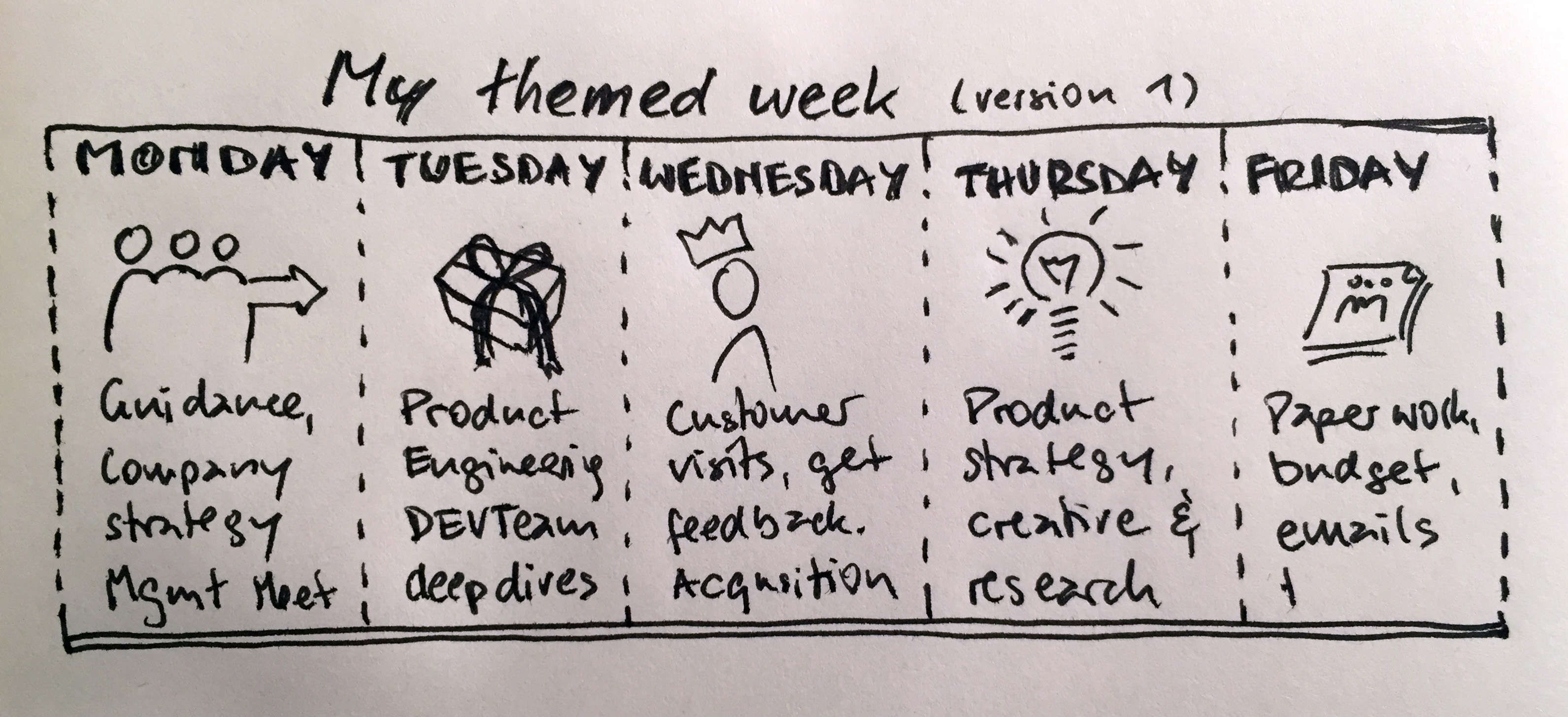
Switching context slows me down. Inability to find a meeting with 3+ colleagues within 2 upcoming days tires me. Now it’s time to make an attempt to change that: I’m picking up the idea of a “themed week”.
That means I put my most prominent recurring activities into a weekly framework. Every day will be dedicated to a specific topic and activities centered around that. What does that look like for me?
Gerade einen schönen Eintrag auf “Smartblog on Leadership” gefunden: Internationale Junge Unternehmer wurden gefragt, welche Angewohnheit sie für sich gestrichen haben, um ihren Führungsstil zu verbessern. 12 Antworten wurden dort veröffentlicht. Einige sind die üblichen Verdächtigen. Andere Antworten sind nicht unter den geläufigen 1001 Tipps. Hier eine gekürzte Auswahl: Continue reading “12 schlechte Angewohnheiten und wie sie Deinen Führungsstil beeinflussen”→
Two toggles – 4 states. Adding just one is simple, but doubles the states to 8. To maintain, understand, test, communicate this added complexity can ruin your product.
“How hard would it be…?” and “can’t you just…” are questions I’m just too familiar with. Leading the software department for our 21+ car2go locations and increasing moovel cities, I get to know all the ideas for cool new features, operational improvement wishes or backlog items we always wanted to realize. But it’s good not to jump on everything right away. On the long run, it pays off to thoroughly analyze every new idea and its potential implementation strategies to identify complexity cost. The goal is to not let this hidden cost pile up as technological debt which makes every refactoring a night mare and introduction of new features more complex.
In his article, Kris Gale (kgale) points out ways to identify and manage that complexity cost. He provides real-world examples, shows that the “value is in what gets used, not what gets built” and focuses on simplicity on product management and implementation. A good read for you and definitely for your colleagues!
 Just received my deck of Clarity Cards by